
In an age of total measurability, financial services are often reduced to a mere commodity.
Yet the creation and preservation of real value follow a different logic. Here, value is not simply a numerical metric; it reflects an ethos grounded in trust and enablement. At Westend Bank, we therefore see banking as a form of bespoke precision —providing the structural integrity required to realise our principals’ visions.
When family offices, private equity firms and sophisticated institutional investors seek to implement their own financing strategies—such as debt funds—they inevitably encounter regulatory boundaries. As they typically lack a banking licence, Westend Bank acts as a strategic enabler, providing its regulatory infrastructure as a discreet and highly precise foundation.
But in day-to-day operations, who actually manages the ongoing relationship with the borrower—the point of contact? This is an exploration of the fine craft of communication beyond standardised processes.
Two Models, One Purpose: Fronting versus Credit Mandates.
To manage communication flows effectively throughout the credit lifecycle, it is essential to distinguish clearly between our two core structural models. While both provide sophisticated investors with access to debt markets, they differ significantly in their operational execution. A detailed explanation can be found in our foundational articles on fronting and credit mandates.
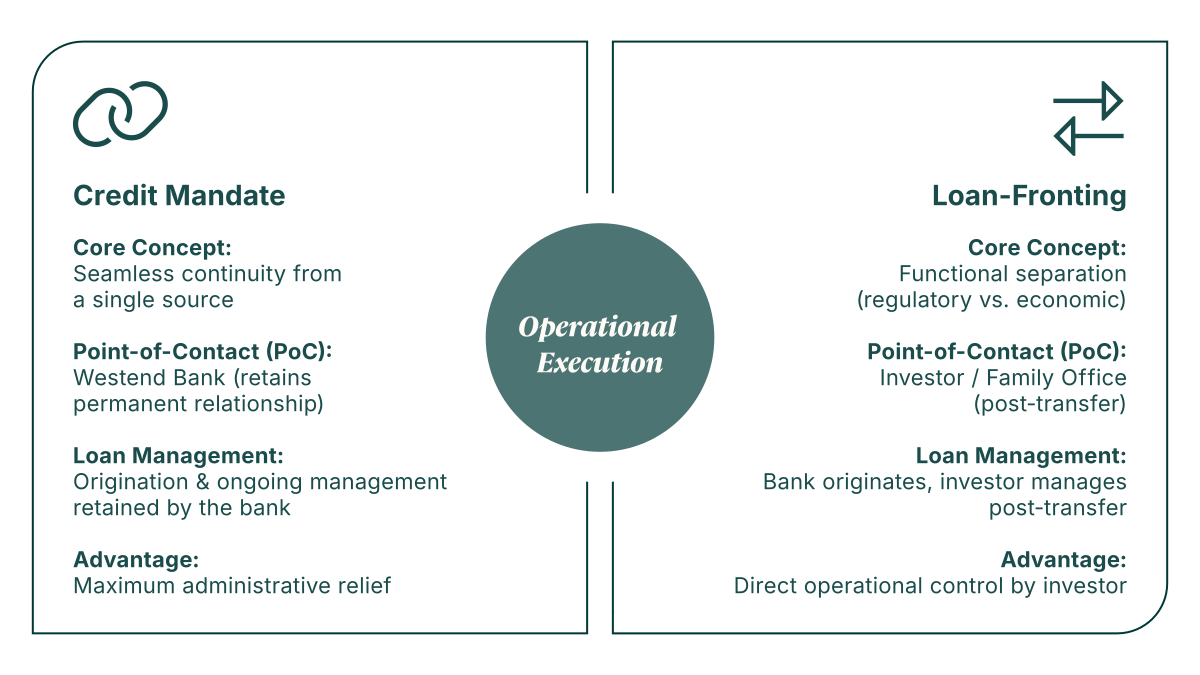
Under a classic credit mandate, the principal opts for continuity from a single source. Westend Bank not only originates the loan using its banking licence but also retains full responsibility for loan administration after drawdown. For the borrower, this means a consistent point of contact: our institution. All operational interaction, credit monitoring and regulatory reporting remain under our stewardship—ensuring maximum administrative relief and discreet, high-quality support.
By contrast, the fronting model deliberately separates regulatory function from economic ownership. Here, Westend Bank focuses on activities that strictly require a banking licence—most notably independent credit assessment and the legal structuring of the transaction.
Following drawdown, the credit relationship is transferred to the investor or family office through the sale of the loan receivable. With this complete and irrevocable transfer, the operational interface shifts accordingly: the investor assumes full responsibility for managing the loan and becomes the direct point of contact for the borrower.
How does the point of contact differ between fronting and a credit mandate?
In a fronting structure, once the receivable has been fully transferred, the investor becomes the primary point of contact. Under a credit mandate, Westend Bank continues to manage the borrower relationship throughout. This allows principals to decide whether to retain direct commercial dialogue or delegate it entirely to the bank.
What role does the banking licence play in borrower communication?
The banking licence provides the regulatory foundation that enables non-banks to access lending markets in a legally secure way. The bank ensures compliance with KYC and AML requirements and conducts independent credit risk assessments. It effectively creates the legal framework within which the point of contact operates. For further detail, see our article “The Architecture of Freedom: Banking-as-a-Service as a Resonance Chamber for Institutional Visions”.
Why is a clearly defined interface crucial for family offices?
A precise interface framework protects the reputation of all parties and clearly separates regulatory oversight from commercial relationship management. This avoids misunderstandings during ongoing credit monitoring and ensures that Westend Bank’s principle of partnership of equals is upheld throughout the transaction.

“The banking licence provides the legally secure environment; the human interface ensures lasting structural integrity. In Beyond Banking, the point of contact embodies the active promise of a partnership of equals.”
The Regulatory Shield and the Preservation of Reputation.
Regardless of the chosen model, compliance with the regulatory framework remains the non-negotiable foundation. As a specialised niche bank, we act as a reliable safeguard for our principals’ reputation. Before any point of contact becomes operational, all KYC procedures and strict AML requirements must be fully satisfied.
We do not see this thorough upfront assessment as a bureaucratic hurdle, but as the essential “architecture of trust” that protects the integrity of the entire system. In the fronting model, this rigorous regulatory groundwork allows the loan receivable to be transferred to the investor in a legally sound and flawless state.
When the investor subsequently takes over operational communication, they do so on a solid regulatory footing. The bank ensures compliance with the German Banking Act (KWG) and the Minimum Requirements for Risk Management (MaRisk), enabling a clear and structured commercial dialogue between investor and borrower.

The best solutions are built through dialogue. Let us examine the foundations of your vision together.
A Practical Insight: Structured Governance for a Project Company.
A practical example illustrates how finely calibrated communication structures work in reality. An experienced institutional investor sought to finance a project company responsible for delivering a large-scale real estate development. The investor had both the liquidity and sector expertise to define the economic parameters of the loan. However, for the regulated lending activity itself, the investor required a structure that preserved economic control without the burden of running a licensed institution.
Westend Bank structured the transaction as a tailored fronting solution. Key economic terms—such as maturity, interest rate and covenants—were defined in close coordination with the investor, while the final credit decision remained with the bank. The loan was granted in Westend Bank’s name and fully cash-backed by the investor prior to drawdown.
The decisive step for operational communication followed immediately after drawdown: the loan receivable was transferred in full and irrevocably to the investor. As a result, Westend Bank did not assume the economic credit risk, leaving its balance sheet and regulatory ratios unaffected.
For the project company, this ensured access to funding from a regulated banking institution. For the investor, the intended outcome was achieved: full economic control and a direct, long-term relationship with the borrower.
Foresight as a Principle.
Whether operational communication is managed within our institution or used by you as a strategic instrument, every solution at Westend Bank avoids rigid, standardised thinking. Instead, we focus on collaboratively designing tailored structures.
Financial decisions are never purely economic—they are shaped by trust and understanding. We invite you to shape the structure and communication of your next financing project with us, in a discreet dialogue centred on long-term value.

The Foundation for Your Vision
True value emerges through discreet dialogue at eye level. We invite you to shape the foundations for your next vision together with us.
Contact us now