
The stewardship of substantial wealth is far more than a mathematical or regulatory undertaking.
It is an act of responsibility towards the life's work that has been built, towards future generations, and towards the core values that bind a family together. The concept of family office governance, therefore, does not imply a rigid, bureaucratic straitjacket. Rather, it is the living operating system of a sophisticated single or multi-family office. Sound governance translates the overarching family strategy into the day-to-day operations of wealth management, safeguards the pivotal decisions of succession planning, and establishes reliable guardrails for overseeing complex assets.
Yet the more entrepreneurial and diversified investment approaches become, particularly in direct investments in mid-market companies, the more quickly internal controls alone become insufficient. Below, we explore how strategic partnerships, such as regulated fronting models, can bridge this gap. First, it is worth examining the foundation: what does truly resilient governance look like?

“Robust governance does not constrain entrepreneurial action — through intelligent partnerships, it creates the secure space in which that action can flourish.“
The Pillars of Resilient Family Office Governance.
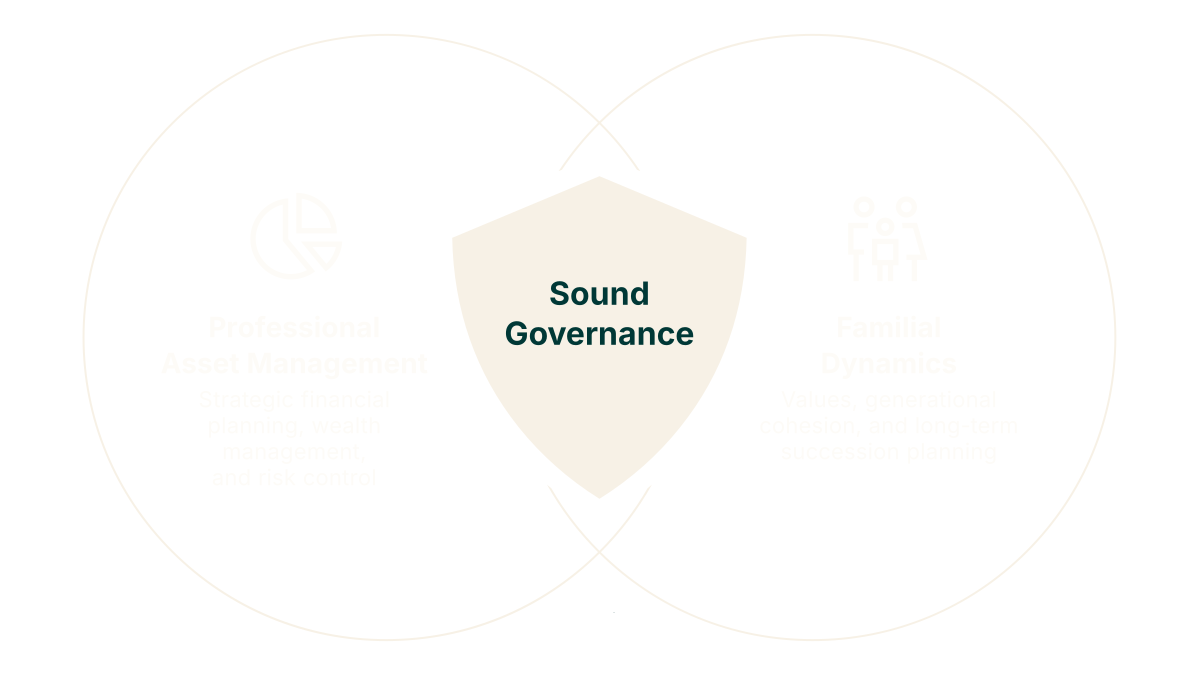
By its very nature, a family office operates at the intersection of highly professional asset management and deep familial dynamics. Sound governance ensures that both spheres work in harmony.
How Do We Know if Family Office Governance is Working?
The true quality of control and leadership structures is rarely revealed in quiet periods. It proves itself when markets turn volatile, strategic generational transitions loom, or complex transactions demand absolute precision. Forward-thinking principals recognise effective governance by three clear indicators:
- Data Sovereignty Rather Than Information Asymmetry: Boards receive accurate, consolidated reporting on total wealth and the activities of external wealth managers at all times without delay.
- Values-Based Decision Pathways: Strategic resolutions are not made reactively or on purely emotional grounds; they follow a transparent process that reflects the family's long-term strategy.
- Freedom to Focus on What Matters: Executive management operates securely within defined parameters, affording the family the freedom to concentrate on their core role: setting strategic direction.
If reports appear incomplete, or if coordination between internal control functions and external managers creates friction, this is a clear signal that existing structures need realignment.
The Optimal Governance Structure: A Proven Board Model.
There is no universal blueprint. Every family and every office has its own distinct DNA. That said, the optimal structure is invariably characterised by a clear functional separation between strategic leadership, operational execution, and independent oversight.
In practice, a three-tier board model has proven highly effective:
- The Family Council (Owner Strategy): Guidelines, values, and long-term succession planning are defined at this level.
- The Supervisory Body (Advisory or Supervisory Board): This body provides ongoing oversight of executive management and quality assurance of external wealth managers.
- Executive Management (Executive Board): Responsible for day-to-day risk and performance management, as well as administrative oversight.
A particular complexity arises when the family office invests directly in portfolio companies. Here, the boundary between pure wealth management and operational co-responsibility in the mid-market becomes blurred, and the demands on the control framework increase accordingly.
Preventing Conflict: How Structure Protects Culture.
Tensions within entrepreneurial families are rarely sparked by purely rational disagreements. More often, they stem from undefined roles, unspoken expectations, or opaque processes. Robust governance serves as an institutionalised safe space.
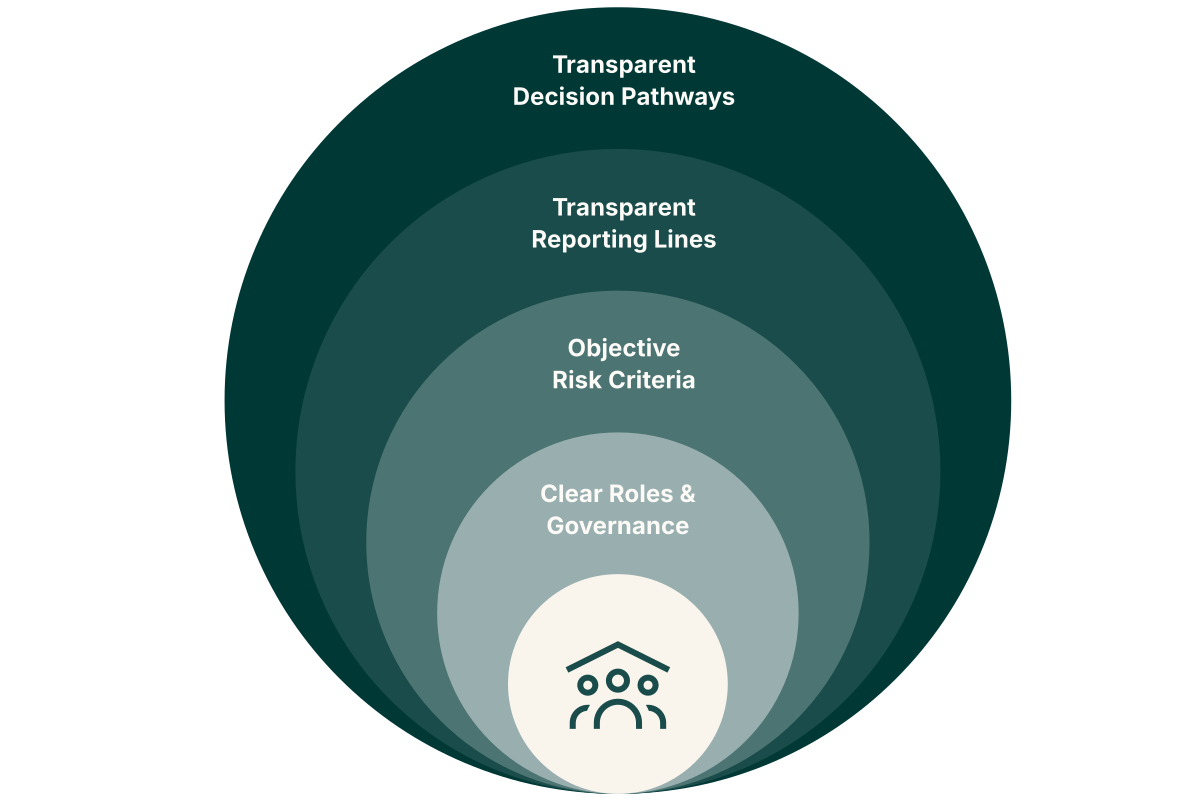
By introducing objective criteria for risk management and clear reporting lines, the conditions for potential misunderstandings are systematically removed. When asset valuations and the financial oversight of investments rest on comprehensible, verifiable data, emotional reactions give way to fact-based discussion at board level. This protects the family's wealth and, above all, preserves harmony across generations.
Governance at the Growth Threshold: Where Internal Controls Reach Their Limits.
The strength of a family office lies in its independence and creative autonomy. Yet it is precisely this strength that generates structural tension as soon as portfolio companies venture into more complex territory: international market entries, regulated transactions, or sophisticated financing structures demand a level of oversight that can barely be maintained internally on a sustained basis. Neither in terms of staffing nor regulatory compliance.
The consequences are familiar in practice. Advisory boards receive consolidated investment reporting with delays or in incomplete form. Transactions in regulated markets cannot be monitored in the real-time that is required, and where a clear legal framework for complex financing structures is absent, difficult-to-quantify risks accumulate. The underlying issue is not an operational failure. It is structural: a governance architecture designed for wealth management reaches its capacity limits the moment the holdings themselves become active market participants.

The best solutions are built through dialogue. Let us examine the foundations of your vision together.
Strategic Partnerships as a Governance Lever.
At this juncture, a structured partnership with a regulated credit institution can purposefully strengthen governance. The principle is straightforward: the regulated partner contributes its compliance infrastructure, reporting standards, and market access, on the basis of clearly defined contractual agreements. The advisory board consequently gains an institutionalised data foundation that relieves the burden on internal control functions and raises board operations to a new level of quality.
What matters here is a correct understanding of roles: a regulated fronting partner is a fully responsible intermediary from a regulatory perspective not simply a tool. The family office, as the principal, retains co-responsibility in economic terms and must reflect this consistently within its own compliance structure. Only transparent, fully documented arrangements unlock the full governance value-add — and satisfy AML regulations and BaFin requirements.
| Criteria | Regulated Fronting Partner | Family Office |
|---|---|---|
| Role | Fully responsible intermediary | Strategic principal |
| Responsibility | Regulatory oversight & compliance | Full economic responsibility |
| Contribution | Infrastructure, reporting standards & market access | Internal compliance framework & strategy |
Recommended Reading: To understand the technical structure of such a fronting model, the applicable regulatory frameworks, and Westend Bank's specific approach as a strategic fronting partner, read our article: Financial Autonomy through Structure: Why Family Offices Rely on Fronting.
Governance as an Enabler of Modern Wealth Architectures.
Future-proof family office governance must not function as a mere control instrument that slows processes down. It should be understood as an enabler: One that reconciles security with entrepreneurial agility.
The decisive levers remain consistent: clear structures, transparent processes, and the willingness to integrate external expertise purposefully and responsibly. Families who embrace governance in this way do not merely protect their wealth. They actively position it for the future.

The Foundation for Your Vision
True value emerges through discreet dialogue at eye level. We invite you to shape the foundations for your next vision together with us.
Contact us now