
In an era of increasingly standardised and automated financial services, individual nuance is too easily overlooked.
Yet substantial wealth, built over decades, demands an entirely different logic. This is where Westend Bank's guiding principle becomes alive: value is so much more than a number.
Managing a family office means taking responsibility for the future — ensuring generational continuity, and steering an entrepreneurial legacy with long-term foresight. That demands solutions which go well beyond off-the-shelf thinking. It calls for bespoke craftsmanship: a tailored approach that brings together financial strength and regulatory expertise in equal measure.
When it comes to financing their own portfolio companies or executing complex transactions, family offices frequently run into a structural obstacle: they lack direct regulatory market access. This is precisely where loan fronting proves its worth as an enabling instrument. To fully appreciate why, it helps to first understand the specific architecture of the parties involved.
What is the Difference Between a Family Office and an Asset Manager?
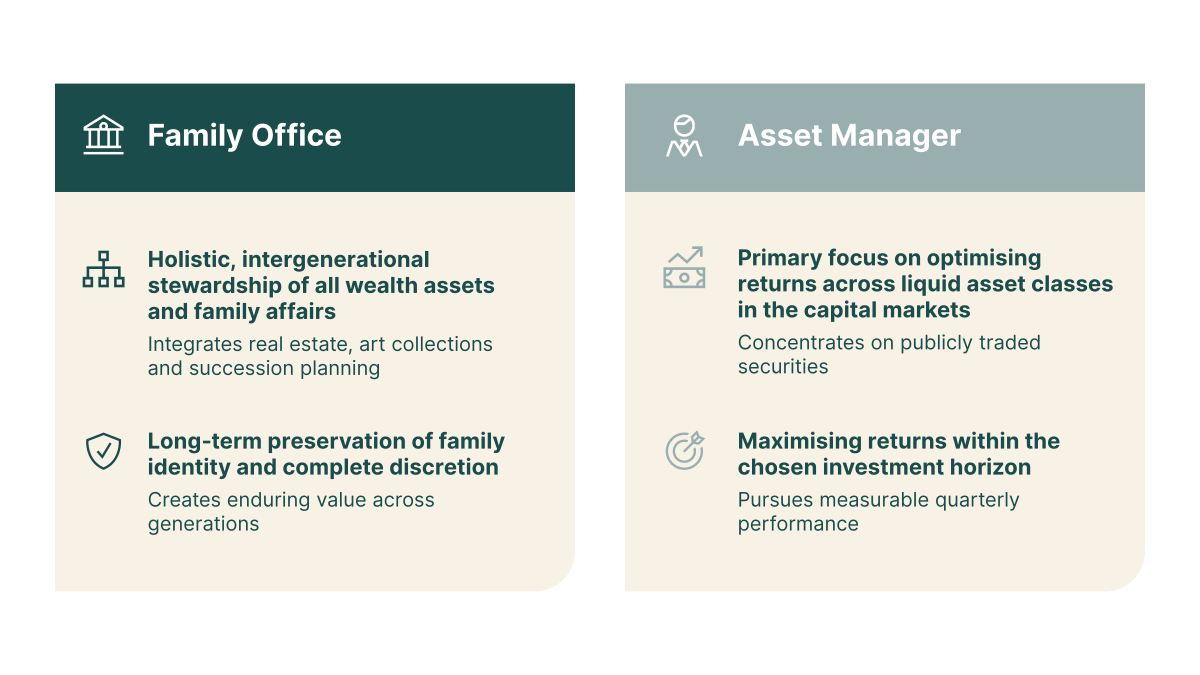
The difference between a family office and a traditional asset manager lies in the holistic, intergenerational stewardship of an entire family's wealth and affairs.
Whilst an asset manager focuses primarily on optimising returns across liquid asset classes in the capital markets, a family office acts as the strategic nerve centre for a family's complete wealth architecture. It integrates direct corporate investments, real estate, private debt, art collections, and succession planning into a coherent, long-term strategy. The goal is not short-term quarterly performance, but the preservation of family identity, absolute discretion, and the creation of enduring value — all of which frequently requires significant capital to be mobilised and deployed.

„When our regulatory infrastructure forms the bedrock for independent financing visions, a symbiosis emerges that is rare in today's financial world: entrepreneurial agility in harmony with banking solidity.“
What is a Single-Family Office?
A single-family office is an exclusive, highly specialised structure dedicated solely to managing, directing, and organising the wealth of one family. In this purest form of wealth management, the owning family enjoys the greatest possible degree of autonomy, confidentiality, and control over all investment and financing decisions. Because both the capital and the entrepreneurial roots stem from a single source, a single-family office can often act with considerable speed and flexibility. Particularly when investing in businesses directly or pursuing proprietary financing strategies beyond standard banking products, access to an external banking licence becomes a decisive advantage.
What Does a Multi-Family Office Do?
A multi-family office, by contrast, pools resources, regulatory expertise, and technological infrastructure to manage the complex wealth of several independent families at the highest professional level. These institutions oversee the complete wealth architecture for a select group of clients, generating valuable synergies in the process. A multi-family office structures capital investments, monitors risk through consolidated reporting, coordinates tax and legal advisers, and regularly provides its client families with access to exclusive investment opportunities that would otherwise be difficult to access — or simply too administratively burdensome — on an individual basis.
The Missing Link: Regulatory Market Access.
Today, both single- and multi-family offices increasingly operate as highly professional capital providers. They acquire stakes in businesses or entire companies, finance project vehicles in the real estate sector, or provide bridge financing for mid-sized enterprises within their portfolios. The financial expertise and the necessary liquidity are firmly in place.
Yet direct implementation runs into a hard boundary: the German Banking Act (Kreditwesengesetz – KWG). Anyone structuring loans on a commercial basis in Germany strictly requires a banking licence. Attempting to route complex financing to portfolio companies without this regulatory framework is not only inefficient — it carries significant legal risk. The family office finds itself in a dilemma: excellent opportunities have been identified, but cannot be executed independently without formal market access.
This is where Westend Bank steps in — not as a traditional lender, but as a strategic enabler for non-banks. The key advantage of fronting for family offices is the ability to draw on a bank's "Architecture of Trust" to bring bespoke financial concepts to life. We provide your projects with the necessary legal solidity, without interfering in your commercial decision-making. In doing so, we ensure that all processes — from Know Your Customer (KYC) identification and rigorous anti-money laundering (AML) checks to the assessment of debt service capacity — fully meet BaFin's expectations and MaRisk requirements.
Recommended reading: For a deeper look at the legal mechanics and how this differs from traditional lending, read our detailed guide on what fronting entails.

The best solutions are built through dialogue. Let us examine the foundations of your vision together.
Fronting as a Reputational Shield: A Real-World Case Study
The practical value of this bespoke approach is best illustrated through our work with an experienced investor whose operational structure and objectives closely mirrored those of a major family office.
Practical Insights: How Visions Take Shape.
The Challenge: A Unique Vision Meets Regulatory Boundaries.
The client planned to finance his own special purpose vehicle (SPV) in full, in order to realise a large-scale real estate project. With deep market knowledge and a robust liquidity position, he was able to define all key parameters independently — from maturity to covenants. What was missing was the institutional bridge to translate this into a legally sound, bank-compliant framework, without the burden of obtaining a banking licence himself.
The Solution: An Architecture of Empowerment.
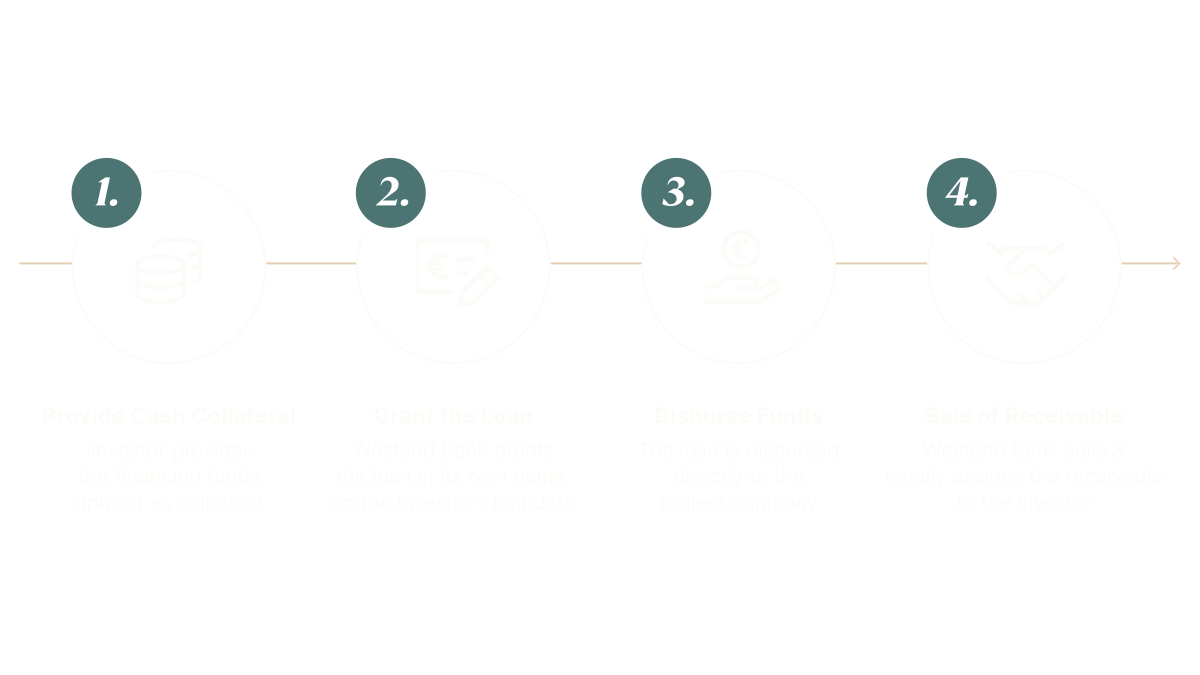
Working in close collaboration, we structured the financing as a precise fronting transaction based on a loan mandate. Westend Bank served as the regulatory foundation: we granted the loan in our own name, but entirely on the economic account of the investor, who backed the funds in full with cash upfront. Immediately following disbursement, the receivable was legally sold and assigned to the investor.
Recommended reading: Our article "The Statics of Responsibility" explores loan mandates as a foundation for entrepreneurial freedom.
The Outcome: Autonomy and Security.
The result was seamless. The project company received funds from a regulated institution, whilst the investor retained full commercial autonomy. Economic risk was cleanly decoupled from the regulatory framework. With Westend Bank managing all anti-money laundering processes and ensuring compliance with BaFin standards, the structure was not only legally watertight — it also served as a genuine reputational shield for the client.
Further fronting examples from our practice can be found here
Partnership Beyond the Standard.
This "Beyond Banking" approach reflects our core philosophy: we act as a trusted partner for those who think in generations. For us, loan fronting represents the intelligent decoupling of regulatory necessity from economic ownership.
To explore the technical details and understand how our models differ, visit our dedicated page on Loan Mandates and Fronting: Market Access for Family Offices and Foundations.

The Foundation for Your Vision
True value emerges through discreet dialogue at eye level. We invite you to shape the foundations for your next vision together with us.
Contact us now