
Visions require space to unfold. Yet, in the modern financial world, this space is often confined by rigid regulatory walls.
While retail banking thinks in standardized grids, supporting complex investment structures demands a language that masters both the nuances of law and the dynamics of entrepreneurship. At Westend Bank, we do not view the provision of our banking license as a technical module, but as a curated foundation. We create the space where visions take on a resilient form—far beyond the interchangeability of ordinary financial products.
The Credit Mandate (Kreditauftrag) pursuant to § 778 of the German Civil Code (BGB) serves as a discreet bridge. It enables actors without their own regulatory framework to direct their liquidity into precise channels and utilize market access otherwise reserved for institutional players. However, sovereignty requires clarity regarding the structural loads that such a construction carries.
What is a Credit Mandate pursuant to § 778 BGB?
At its core, a Credit Mandate under § 778 BGB is a legal mandate through which a principal authorizes a bank to grant credit to a third party in the bank's own name. In Westend Bank’s practice, this means: A client can instruct us to provide targeted lending to an affiliated company or a strategic partner. We utilize our regulatory infrastructure to formally map the financing, while the principal directs the economic intention and the collateralization.
It is a deliberate alliance between entrepreneurial will and banking excellence. The legislator provides a structure in which the bank acts as an intermediary while the principal assumes economic responsibility. For our clients—often investment companies or family offices—this is the key to acting under their own name without having to overcome the administrative and regulatory hurdles of their own banking organization.

"It is a deliberate alliance between entrepreneurial will and banking excellence."
What is the Difference Between a Credit Mandate and a Guarantee?
It is a matter of initiative and chronological sequence. While a classic guarantee (Bürgschaft) usually only provides accessory security for an already existing obligation, the Credit Mandate is the legal prerequisite for the credit institution to execute the lending in the first place. Consequently, in legal terms, the principal is treated like a guarantor, but their role is proactive rather than reactive: they act so that the actual financing assistance or loan can come into being.
A significant advantage lies in transparency and control: liability is not a mere appendage but the structural element that supports the entire framework. This ensures the client maintains strategic control over the terms and the design of the underlying loan. When clients commission us, we provide the regulatory shell as well as highly professional administration and custody of collateral. Thus, the initiative remains with the entrepreneur, while the bank guarantees compliance with regulatory statics.
Which Legal Obligations Arise from a Credit Mandate?
The initiation of a Credit Mandate creates a lasting legal relationship that goes far beyond mere disbursement. Since Westend Bank assumes the creditorship and retains the entire credit management in-house until the end of the term—unlike in traditional loan fronting—we bear the responsibility for regulatory compliance.
This obligation includes continuous risk monitoring according to MaRisk as well as the discreet moderation of disclosure requirements pursuant to § 18 of the German Banking Act (KWG). We view this structure as a form of professional and regulatorily secured financing assistance, where we relieve our clients of the entire operational burden of banking supervision and reporting. This regulatory relief creates the necessary peace of mind to focus fully on the strategic management of capital. Furthermore, by law, the person who commissions us is entitled to the defenses of a guarantor. This means they can invoke the rights of the primary debtor against the bank—a vital shield in any lending arrangement.

True solutions arise from dialogue. Let us examine the structural integrity of your vision together.
Which Security Foundation Supports a Credit Mandate?
In the architecture of the Credit Mandate, Westend Bank assumes a role that goes far beyond mere administration: we act as a regulatory shield for our clients. When a family office instructs us to carry out lending, it simultaneously delegates the complex requirements of banking supervision to a specialized credit institution.
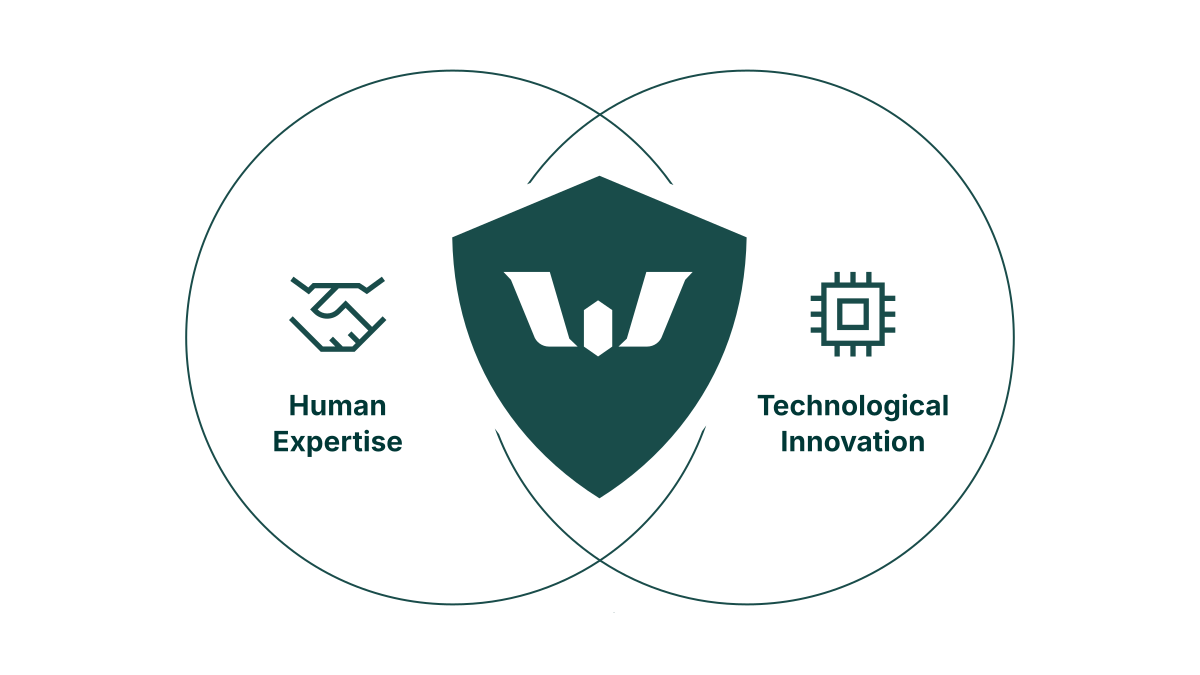
To make this shield as precise and resilient as possible, we rely on a symbiosis of human expertise and pioneering technologies. For us, Artificial Intelligence is not an end in itself, but a precision instrument for maintaining regulatory integrity. Through AI-supported analysis, we validate complex datasets in real-time to ensure predictive compliance and guarantee seamless adherence to all KWG requirements and MaRisk guidelines.
This technological foresight allows us to anticipate potential regulatory shifts early and elevate KYC (Know Your Customer) processes to a level that uncompromisingly protects our clients' reputations. In this way, we transform strict legal requirements into a strategic advantage: we handle the entire operational burden of reporting and provide the necessary peace of mind, linking the diligence of the KWG with the speed of modern algorithms.
Use Case: The Project Company as a Bridge to Realization
The practical resilience of our structures was impressively demonstrated during the support of an institutional investor who wished to realize the financing of a large-volume real estate project via a project company. Despite profound industry expertise and sufficient liquidity, the investor faced the classic hurdle of the regulated market: he possessed the economic power of design but lacked the necessary regulatory "casing" for formal lending. The goal was therefore a solution that secured full economic control for him, while Westend Bank provided its banking license as a protective and legitimizing shell.
To open this market access, the investor decided to commission us with a Credit Mandate pursuant to § 778 BGB as part of a precisely balanced fronting transaction. In this constellation, all parameters—from term and interest rates to covenants—were defined exactly according to the investor's strategic specifications. We disbursed the loan in our own name but strictly for the account of the client, with the amount fully backed by cash collateral in advance. Through the immediate sale and assignment of the claim after disbursement, the transaction remained neutral for our balance sheet, while appearing to the project company as serious financing assistance from a regulated banking institution.
Find further fronting examples from our practice here
Our Philosophy: Innovation and Generational Thinking
A Credit Mandate at Westend Bank is a commitment to quality and permanence. By combining our banking license with modern intelligence and legal precision, we create spaces for visions built on solid ground. Our goal is to use our regulatory expertise to clear your path for what truly matters, while guaranteeing the integrity of your projects for the next generation. True value is created in discreet exchange at eye level.

The Foundation for Your Vision
True value emerges through discreet dialogue at eye level. We invite you to shape the foundations for your next vision together with us.
Contact us now