
Those responsible for preserving substantial family wealth know that the most robust structures rarely announce themselves.
They require an invisible, unshakeable integrity that withstands shifting regulatory frameworks without strain. As financial products become increasingly commoditised, owner-managed capital can lose its strategic discretion within a dense web of statutory requirements. Yet for forward-looking decision-makers, capital allocation is far more than a calculation—it is the expression of a deeply held ethos. Our guiding principle remains: value is so much more than a number.
When family offices act as financiers and seek to open new pathways for portfolio companies, they inevitably encounter the legal framework of the German Banking Act (KWG). Rather than forcing themselves into a rigid administrative structure, they draw on our bespoke expertise. We provide our banking licence to build the strategic bridges that would otherwise remain closed without regulatory exemption—creating a legally secure environment and an uncompromising shield for the family name.
Requirements and Mechanism.
Under Section 2(1) No. 7 of the KWG, the intra-group exemption releases companies from the licensing requirement for banking and financial services, provided that transactions are conducted exclusively between parent companies, subsidiaries or sister companies within a legally defined corporate group. The Federal Financial Supervisory Authority (BaFin) has issued specific guidance on the scenarios in which a licence under the KWG or the German Investment Code (KAGB) is required.
In practice, however, this foundation frequently proves insufficient for sophisticated family wealth structures. Due to fiscal considerations or family governance decisions, holding companies, wealth management entities and foundations are often structured in ways that prevent them from forming a qualifying corporate group under Section 2(1) No. 7 KWG. Where external project developers or portfolio companies—in which the office holds only a minority stake—are to be provided with debt capital directly, the intra-group exemption will generally not apply.
BaFin interprets the boundaries of this exemption strictly. Lending outside the privileged group perimeter—where conducted on a commercial basis or at a scale requiring an organised business operation—can trigger the licensing requirement under Section 32 KWG. In the absence of such authorisation, this constitutes unauthorised lending under Section 54 KWG. In credit-linked structures in particular, BaFin ensures that family offices do not effectively operate as credit institutions without a licence—a regulatory risk with serious implications for substantial wealth structures.
Distinction and Regulatory Practice.
In regulatory practice, the KWG draws a clear line between the licensed primary origination of loans and the subsequent acquisition of existing loan receivables—the latter generally remaining licence-free for private actors, unless it meets the criteria for licensable factoring under Section 1(1a) sentence 2 No. 9 KWG. This distinction forms the basis for alternative operational strategies and sound capital allocation.
While the act of credit creation—meaning initial execution and drawdown—is strictly reserved for a licensed institution, the secondary market for purchasing receivables remains accessible to private actors within statutory limits.
That said, structuring debt financing in this way requires continuous and careful distinction from collective investment schemes. As soon as capital from multiple unconnected investors is pooled, the provisions of the KAGB may apply, reclassifying the structure as a regulated investment fund. The boundary between individual wealth management and a regulated fund is narrow; crossing it brings the full scope of the KAGB's requirements and typically necessitates a corresponding licence.
Continuous structural monitoring is therefore essential. Family offices operate in the tension between the KWG intra-group exemption and the KAGB's investment fund provisions. BaFin's published guidance notices provide vital orientation for identifying licensing requirements early and designing one's own framework with legal certainty.

The best solutions are built through dialogue. Let us examine the foundations of your vision together.
Operational Alternatives Without a Dedicated Banking Licence.
Legally secure alternatives for wealth management entities without their own banking licence include loan fronting via an authorised institution, the issuance of bearer bonds (subject to securities prospectus law and potentially further requirements depending on structuring), and restricting activity to shareholder loans within the relevant statutory exemptions. Whether any activity constitutes licensable banking business depends not on a single loan in isolation, but on the overall pattern of activity of the wealth management entity.
Given that establishing a dedicated credit institution is disproportionate in most cases—requiring initial capital of at least EUR 5 million under Section 33 KWG alongside a comprehensive regulatory framework—the fronting model stands out as a particularly robust and flexible solution. How loan fronting also reduces dependence on systemically important banks and opens alternative financing pathways is explored in our article "Financial Control beyond Systemic Importance: The Structural Integrity of Autonomy.".
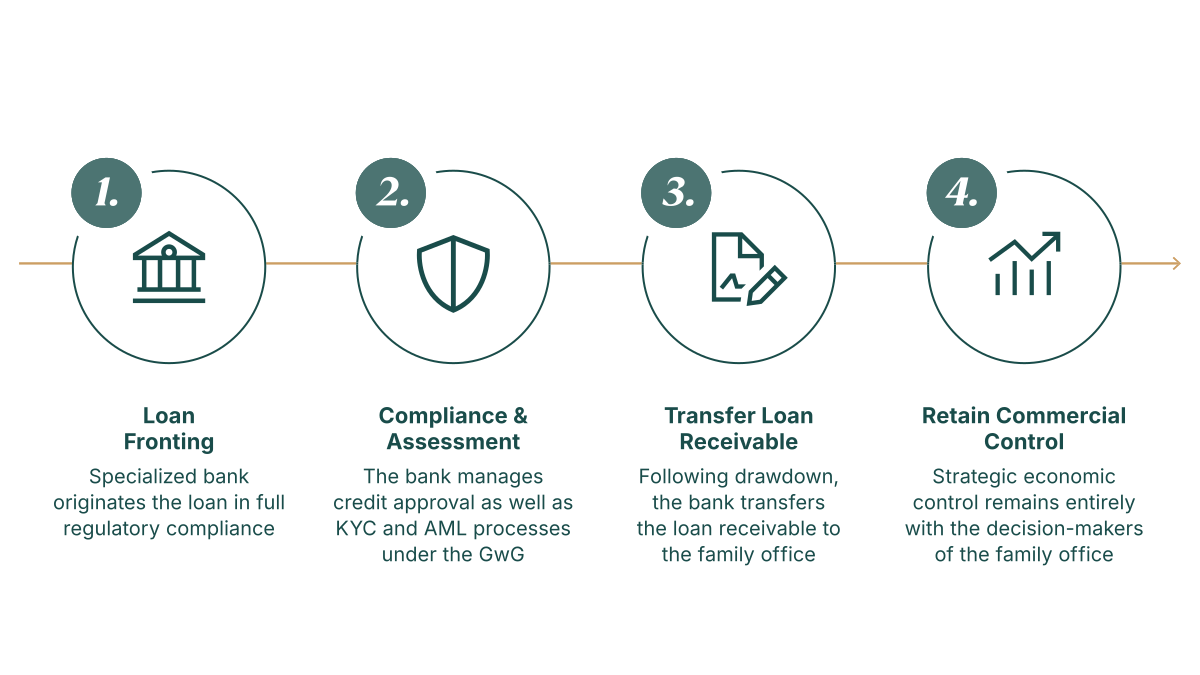
A specialised bank originates the loan in a regulatory-compliant manner, manages credit approval, KYC and AML processes under the German Money Laundering Act (GwG), and transfers the receivable to the family office following drawdown. Strategic economic control remains with the principal, while regulatory responsibility for lending under the KWG is consolidated within the licensed banking partner—with the investor retaining ongoing obligations regarding anti-money laundering and tax compliance. Effective stewardship of family wealth also means understanding one's own role under regulatory law and rigorously respecting the boundaries between asset management, investment management and credit-linked activities.

"Real financial autonomy has little to do with holding a banking licence; it lies in the certainty of a legally sound framework that preserves value across generations."
Case Study: Complex Project Finance.
A practical example illustrates how a sound regulatory framework can protect creative freedom in financing. An entrepreneurial corporate group was developing a large-scale residential quarter comprising approximately 500 units, associated parking and a total area of 35,000 square metres. As construction progressed, the equity investor sought to refinance an existing equity arrangement ahead of schedule—aiming to improve the group's financial flexibility and meaningfully reduce ongoing costs.
As the investor lacked authorisation to engage in commercial lending to third parties, the transaction risked foundering on the regulatory boundaries outlined above. Working closely together, Westend Bank structured a tailored solution: a bespoke loan was formally extended in the bank's own name to refinance the legacy debt, operating on the basis of a legally secure credit mandate on behalf of the capital provider. The latter fully collateralised the loan with cash deposited into separate fixed-term accounts at market-rate interest.
To align the structure with the construction and sales progress of the development, a dynamic release mechanism was established: as the project developer made scheduled repayments, the cash collateral was incrementally reduced and returned to the client. The contract also granted the corporate group the option to repay at any time, without rigid early redemption penalties.
Aligning one's structure with BaFin's guidelines not only creates legally secure latitude but also builds the confidence of partners and stakeholders. Through this framework, the equity structure of the development was optimised, while the capital provider managed his investment with full legal certainty and transparency—without incurring the regulatory exposure of unauthorised banking business.

The Foundation for Your Vision
True value emerges through discreet dialogue at eye level. We invite you to shape the foundations for your next vision together with us.
Contact us now